
I stole my title. I stole it from TJ Clark. It’s also the title of my favorite book on art writing and one of my favorite books of all time. He wrote it. However, I think the title may be more appropriate for the writing I’m doing than even his book. For the first time in quite a long time, I’m sitting down to write about a piece (work?) of art that I love. It’s hanging in my living room. Twin Fawns, it’s called. I would normally never offer up the title this early. Altogether too revealing. I prefer to be withholding. And I subscribe to the “no Jesus” school of art writing. Advice given to me that I’ve never forgotten, the “no Jesus” rule simply means that even if one knows, can see, or is aware that a painting is of, about, or even by Jesus Christ himself, one should not mention it when writing about the aesthetic elements of that painting. Or of any medium, really. It’s altogether naïve fantasy that this is even possible, but the experiment of forcing one’s mind to recontextualize aesthetic elements outside of knowable things or categorical boundaries has always produced good results for me. Pages and pages of them, in fact. I’ve also been told it’s highly pretentious and is a luxury only afforded to the most established and skillful art writers. Boundaries are an interesting thing. I erred on the side of caution, making sure to follow the rule by having my writing always be skillful. That wasn’t the answers my critics were looking for, but it was satisfactory for me.
I’m attempting to reactivate those muscles here, but I’m not sure what approach yet to take. My writing has always been academic, a requirement that I’m no longer beholden to and yet yearn for its inherent intellectual freedom and inflexibility in its rigor. In The Sight of Death (TJ Clark’s, not mine), he attempts to write about two Poussin paintings set across from each other at The Getty. He attempts to write about them in aesthetic terms, coming back to them for months at a time in a diaristic endeavor to find something out about the paintings. He all too quickly falls back on the historical context and literal aspects of the painting for me to be satisfied, but the experiment is compelling and illuminating, nonetheless. Just by page fifty or so, he’s talking in great detail about Poussin’s dealer, collector, and the context in which the paintings existed. Marxist habits die hard. My usual tendency is toward the opposite approach, never mentioning the literal, or putting it off for as long as possible. That is, until the art history happens. I think I may try to do and not do that here. Starting with what we’re looking at categorically might take me places.
But that’s also because what I’m writing about today is photography. I hate writing about photography. The internal impossibility of painting being anything but a creative reconstruction or construction, a mere reference in color and texture to other things, makes it easier to entrap within the lasso of syntax. The fact that it is paint makes it easier to believe it’s not Jesus. Photography does not have such a conceit. Its conceit (equally fictional) is that it is capturing something in the world whence seen or that could be seen by eyes. Some painting does attempt this, but the lie is more blatant. The lie of photographic veracity has just been smothered a bit by our own belief in the photo-realism of optics. But here I am, choosing for my first rodeo back to write about a photograph.
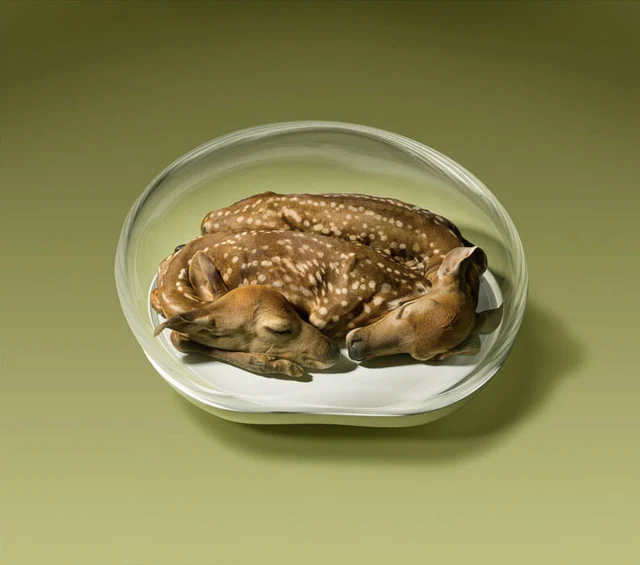
Ironically, I don’t have it in front of me at the moment even though I own it. The photograph itself is by Peregrine Honig, a finalist on Bravo’s defunct reality show Work of Art: The Next Great American Artist. Think of Project Runway, but for artists. The show was both horrific in quality and one of the best things I’ve ever watched. When I saw this photograph on the show, I knew I had to have it. It was a perfect conflux of my interests, and the work is exceptional. I’m not want to do the big reveal yet, but in the spirit of writing in a new way I will reveal that the photograph is of two fawns curled around one another within a glass dome. The fawns are dead. They appear to be sleeping, but it is in fact a work of posed taxidermy that has been photographed.
Against an ombre green background, fading from a not too dark, dark green of blackish tonality at the top to a lighter, whitely tinged khaki green at the very bottom, the fawns are set in the center. Unlike much taxidermy, their eyes are closed. Although against the conventional nature of an art form meant to suspend the motion of life, this detail makes it all the more unsettling to intuit that the fawns are dead and not just slumbering. Adorable in their collective morbidity, they suggest softly that their life is just beginning and yet has truly never been. Never have I more wanted to touch taxidermy to see if I can wake it up. To breathe life back into their corpses by making my presence known. However, look on is what I must do, and what I’ve chosen to do. I’m struggling to turn back to mere visual elements that I usually find comforting. But they matter deeply here. The photograph, unlike much painting, readily admits to the fact that it has been captured or constructed from something in the world. This photograph refuses the usual truth-value of the medium. Even in its most obvious reference to photographic technique, the phasing of darkness to light as one slips down the side of the image, the details appear painterly. Twin Fawns is thoughtfully constructed and yet naturalistic enough to suggest, not entirely admit to, its construction.
The crux of the painterly photograph lies in the white tones that shade the glass encasement of the fawns. Shimmers of white curvature slither across the outline of the case, gently abutting darker black, grey, and blackish green lines; light and dark: the photograph. The problem, here, is that as an effect of painting I would call them wholly unconvincing. The way the light bounces off the case makes its edges appear both smoothly egglike and only possibly made of too many long, curved divots for a glass shell. It’s both perfectly round and incredibly flat at each edge of the sphere. I imagine there’s a Dutch technical word for how Vermeer uses light to illustrate his famous water pitchers and metal accessories that I can’t remember but would likely perfectly encapsulate the effect at play. If it were someone painting after Vermeer, I would call it so confusingly rendered as to be one of the most brilliantly interesting painting effects I’ve ever seen. But it’s a photograph. How do I write about it as a photograph!
The fundamental inability for the dome to be perceived as a coherent object within the photograph (its glass mediating the subject just as the glass of the frame mediates the domesticated photograph itself) belies any confidence one might have in the act of perception as a moment of capture. And yet, is that not the central tenet of the work itself? I originally thought our view of the fawns was mediated thrice. We see through the glass frame, through the photograph, and through the glass case. There are yet more. We see through our eyes, to see through the glass frame, to see through the lens of the camera, to see through the framing of the artist, to see through the photograph, to see through the glass case, to never see through the eyelids of the fawns (of course, there are still more). The unavailability of their glassy eyes is the final frontier of our (my) inability to instinctively perceive of it as taxidermy. As death. I only know this fact secondhand. If you told me I was lied to and they were simply sleeping fawns, I might just believe you.
I’ve written about taxidermy before, but it wasn’t what I wanted it to be. The crux of life and death were avoided as I wrote about 19th century Muybridge motion studies, theme park taxidermy, and the zoo. I imagine it’s because the things I wrote about were too believable as capture. The animals had been captured, the taxidermy had its eyes wide open in a way that admitted readily to its own death, and the studies of motion were inherently fixed. These fawns, these sleeping dead fawns, deny the conceptual acquisition of their death or even of a mere moment in time in which they were alive. Sleep is rarely but a moment; their perpetual state in the perpetual state, or perhaps annular state, of sleep is uninterruptable and imperceptible while the only thing one can do is perceive it. Perceive that they’re not sleeping? Perceive that they’re dead? Yet the word dead seems inherently incorrect for what’s happening here. They lack the claim to a moment that affixes taxidermy outside of time; that affixes photography within it. The moment of death is snatched away.
Oscar Wilde wrote, “‘How sad it is! Murmured Dorian Gray with his eyes still fixed upon his own portrait. ‘How sad it is! I shall grow old, and horrible, and dreadful. But this picture will always remain young.’” Dorian would never have gotten over this photograph. Dorian really understood art.
In a sense, Dorian was himself taxidermized. I wish the word was taxidermied but we’re stuck with the too distinctly antecedent -ized. -ied has been done, is being has been done; -ized happened. This photograph -ied. It was photographied, not taken. I had been thinking about taxidermy all wrong. Taxidermy is the suspension of time, not life; the objectification of the concept of vitality; the oxymoronic nature of much art. To turn the vital to an object is to turn the suspended state of sleep into that of death. An imperceptible, theoretically impossible, turn from a state of timelessness to permanence. The conceptual possibility offered by Dorian and by Twin Fawns is both. Timelessly living and slumbering dead. Their utter refusal of the suspension of life, of time, makes them both the epitome of art and its platonic opposite. The object and the thought; the object and the feeling; the object and the moment; the object and the art.
To be a thought and an artwork, or thoughts and an artwork, is the conceptual necessity and impossibility of art. Twin Fawns upsets this not by being a thought, but by being a rejection of time. Its affect is a snake eating its tail of quaint pastoral cuteness and the immeasurably sad death of two animals. They’re adorably dead.
I modeled a large portion of my living room around the active suspension of life, something that I didn’t think would mean so much to me, about me, now. Thematically it wasn’t so hard to do; elements of that which were once alive and moments in time in which I thought I might be able to live are scattered about in an arrangement only I could perceive as meaningful. I thought I could capture these moments as thoughts. Twin Fawns, of course, shows that I couldn’t. For what even is a moment if not something that needs to be conceived of as a thought, and how could we possibly suspend a thought in an object? But what I’ve found is that a moment is not just a thought, an exercise in cognition, but a feeling in time momentarily captured in memory yet ever incapable of being caught.
Emotions often manifest as the lack of control over thoughts. For me, at least. Or perhaps a dismissal of them for a moment in time; a moment akin to sleep in its feeling of timelessness. The feeling antithetical to the absolutism of death. Death can be experienced during life as sleepwalking. Art can’t really sleepwalk. Dorian couldn’t. I couldn’t. And yet, to experience is never to truly understand. We can’t capture a moment.
I’m not sure if this practice will continue, but I wrote this in one sitting. I have one hundred more visual observations about the fawns and far too many hanging chads of thought to be satisfied here, but I’m going to take a break from my thoughts and go live life.