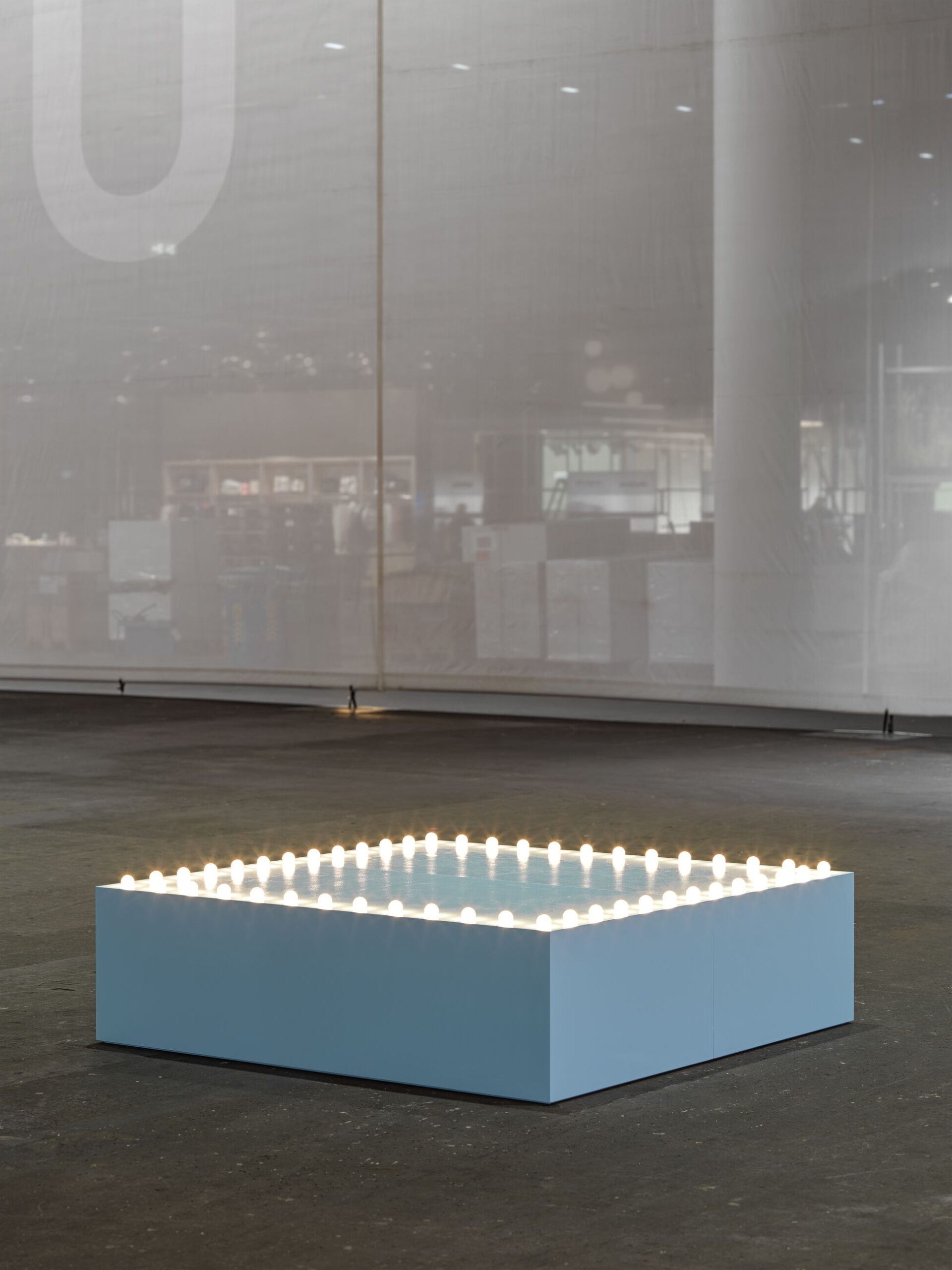

When I first saw this, I didn’t think about who the dancer was. I realized about ten minutes after looking at the piece that I hadn’t considered it. I was reading through the comments on the Hauser and Wirth Instagram post advertising their showing of “Untitled” Go-Go Dancing Platform at Art Basel when I came across a comment by Gary Yan, “From another former Torres Gogo-boy with ❤️🔥”. Those emoji are softer than the ones Yan chose. Rounder, with less shine and contrast between the colors. Yan danced in the “first all Asian gogoboy cohort” when Untitled was first displayed in China at the Rockbund Museum. I now know who Gary Yan is, but I haven’t seen him dance.
I’ve clicked (or more aptly tapped with the pad of my finger) on the username for the go-go boy in the Hauser and Wirth post but I don’t remember who he is. I’m not sure if I was initially more taken by the dancer or the platform, but I’m certainly more taken by the platform right now. The fact that I can’t remember him probably attests to that. I’ve read multiple accounts of the work in which viewers were fascinated by specific go-go boys; I’m also not sure whether or not I like that more or less than forgetting who they are.
The short video I watched of a boy in a silver speedo, 80’s style high athletic socks with black bands, and white sneakers ch- ch- as his shoes shimmy across the platform reifies a 5-minute moment that is actually quite uncommon to an experience with the work. Silently squeaking to music only audible in his own wired headphones, the go-go boy offers a point of intrigue in a work otherwise premised on melancholic absence: a great clip for the gallery to post on their Instagram. This is not to say the go-go portion is a less important, or even less honest, part of the work, but that this very short moment in time has had an outsized effect on perceptions of the work both in person and digitally. 5 minutes of the day with a dancer, 1,435 minutes of the day alone.
Gonzalez-Torres created this work in 1991, shortly after the death of his long-term boyfriend and the death of his father. The incredibly gay nature of the go-go platform has also led to the death of his father becoming a minor note in any tale told about Untitled. The work’s resonance with the AIDS crisis, the cause of death of his partner and the gay tragedy of the late 20th century, is undeniable and profoundly sad. A Tiffany blue dancing platform, the top bordered with spherical white lights, waiting for someone to dance to the tune of the death of Gonzalez-Torres’s loved ones. It feels bizarre to cry to the thought of a go-go boy dancing on a platform, or the thought of when he’s not. The imminent sadness of Untitled is offset by the extensive time the work spends unoccupied. It’s much sadder to me when the platform has nobody on it.
I might like the work too much, and I probably like the guy who made it too much. I’m charmed by the depths of his despair.
I’ve been thinking a lot lately about time. About the sense of a moment. What it feels like to experience something and how it feels to experience it in the rear-view mirror. Untitled largely occupies the absence of its moment. The go-go boy is the star of the Instagram post, the star of the think piece, the star of many imaginary conceptions of what the work is. And yet, what Untitled most often does is be alone with its own despair. Grief is a funny thing in that way. It extends outwards and upwards and backwards, consuming you before you even have any reason to feel it at all. When does something really end. When does it die. The beginning of the end of something is so often well before the end really happens, after all. One can sit in a perpetual state of grief for quite a while while getting ready to actually experience it. Waiting for your own skeleton to finally dance on the platform. Waiting for its moment: the 5 minutes you spend with someone who is going to have 1,435 minutes of a completely different life, or death. The empty box, a moment vacated.
The experience of Untitled is belated but perpetual; always done but never done. The dancer has always already danced and is always about to. What is a moment: when you’re looking at the go-go platform? Is the moment the dancing? The waiting? The time when the dancer is walking up the platform? Right when he’s about to begin? In one sense, the moment for Untitled really is the 5-minute dance. A 5-minute-long moment. 300 seconds of moments. Would one truly experience the work if they missed the moment of the dance? Of course, yes and of course, no.
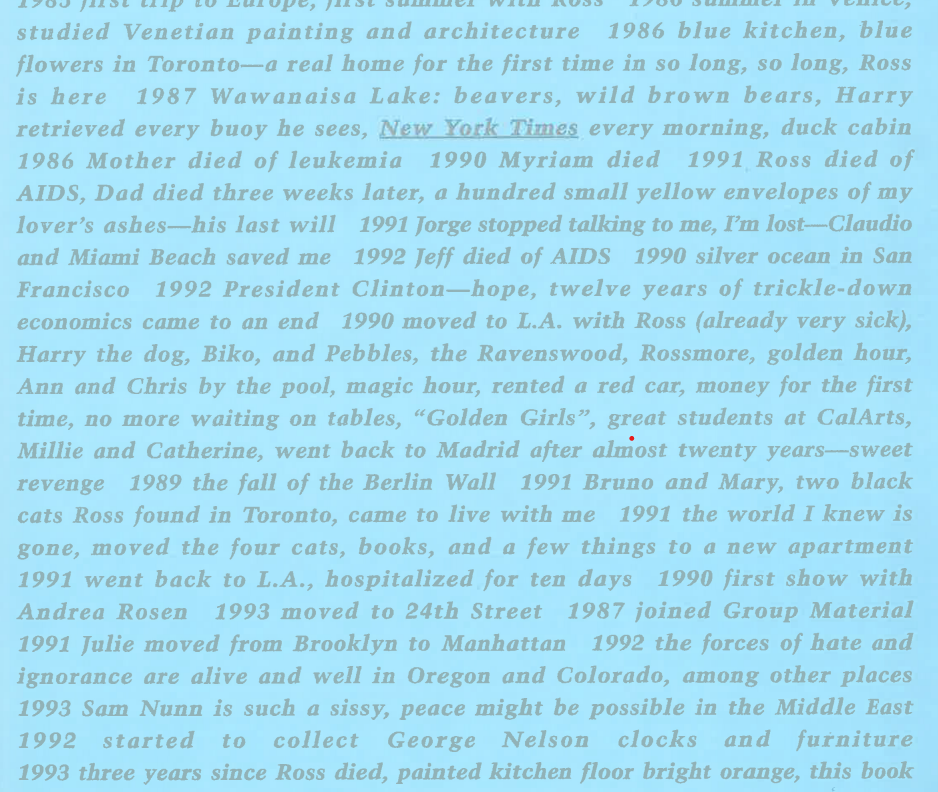
In his incredibly blue self-written biography published in 1993, Gonzalez-Torres writes, “1987 Wawanaisa Lake: beavers, wild brown bears, Harry retrieved every buoy he sees, New York Times every morning, duck cabin 1986 Mother died of leukemia 1990 Myriam died 1991 Ross died of AIDS, Dad died three weeks later, a hundred small yellow envelopes of my lover's ashes-his last will 1991 Jorge stopped talking to me, I'm lost-Claudio and Miami Beach saved me 1992 Jeff died of AIDS 1990 silver ocean in San Francisco 1992 President Clinton-hope, twelve years of trickle-down economics came to an end 1990 moved to L.A. with Ross (already very sick), Harry the dog, Biko, and Pebbles, the Ravenswood, Rossmore, golden hour, Ann and Chris by the pool, magic hour, rented a red car, money for the first time, no more waiting on tables, "Golden Girls", great students at CalArts, Millie and Catherine, went back to Madrid after almost twenty years-sweet revenge 1989 the fall of the Berlin Wall 1991 Bruno and Mary, two black cats Ross found in Toronto, came to live with me 1991 the world I knew is gone, moved the four cats, books, and a few things to a new apartment 1991 went back to L.A., hospitalized for ten days”
Weeks and years push and pull and pile onto each other, punctuated by what are likely the most horrific events of his life. Each moment lost in the sea of its neighboring ones. And yet, these were likely not just moments for him. The death of his partner, I write as if this singular instance of going from living to dying was the thing that was saddest. This most momentary tragic moment was surely its own sea of grief, fed by the saline tears of days and hours and moments and seconds and years of knowing and not knowing if someone was going to die while they’re dying.
Time is funny in that way. It’s always already over. By the time our nerves zip our senses to where we process them, we’ve passed into having a past. But sometimes things feel longer. Or shorter. I’ve had days that feel like moments and moments that feel like days. I don’t know what to make of it, the procession of time at different rhythms. Untitled has its own supposed rhythm, but it’s never disclosed. Nor, I imagine, timely. The 5 minutes of dancing, occurring only once a day, happens at a supposedly random time. You can’t come to wherever the work is being shown just to see the dance, it has to happen to you. Unless you’re willing to wait; to watch an empty platform for hours waiting for its moment.
Before now, I hadn’t even thought that the lights of the platform might go off at night. That the time the work is alone is punctuated by its own kind of absence, only witnessed by the person with the unfortunate job of leaving last.